
Interpretation of results – 2D barcode verification
All barcode verifiers must use a standardised lighting configuration, with light of a specified wavelength, to take an image of the barcode. This image is then analysed using a known sampling area (defined as the aperture reference) to measure eight different aspects, or parameters, of the symbol.
Unlike linear barcode verifiers, only one image is used. The eight parameters are each measured, and the measurements converted into grades given to one decimal place. The best grade is 4.0, a failure is 0.0, and the parameter with the lowest grade becomes the overall grade for the 2D symbol.
The grade is then reported with the details of the aperture, the light, and the angle of illumination as follows:
N.0/aa/www/30/45/90 where N.0 is the grade, aa is the aperture refence number, which refers to the diameter of the aperture measured in 1/1000s of an inch, www is the wavelength of light measured in nm, and 30 or 45 or 90 is the angle of the incident light used to illuminate the barcode.
The eight parameters of 2D barcode verification are all briefly explained below:

The ISO/IEC verification parameters
Decode
This is the first step in the verification and applies the reference decode algorithm – the set of rules defined by ISO/IEC for decoding the symbol – to the image. If there is a valid decode, the grade is 4.0. If the barcode cannot be decoded, the grade is 0.0.
Symbol contrast
The symbol contrast is the difference between the darkest and lightest areas of the barcode. The quiet zones will normally be the lightest areas. This is measured in percentage terms, and the percentages are converted into 41 different bands – 4.0, 3.9 and so on down to 0.1 and 0.0.
Axial non-uniformity
All matrix 2D symbols should comprise perfectly square, and evenly spaced, elements. Axial non-uniformity is a measure of how out of square the barcode is when checked against its horizontal and vertical axes. This is measured and then graded from 4.0 to 0.0.
Modulation
A barcode should be evenly black and white across its whole area. Modulation compares the least black-to-white area of the symbol to the greatest difference between the black and white elements. This is measured and then graded from 4.0 to 0.0.
Grid non-uniformity
Grid non-uniformity measures how the symbol is distorted in terms of incorrect positions for where the centres of the black and white modules should be. This is measured and then graded from 4.0 to 0.0.
Unused error correction
All matrix 2D symbols include error- correction characters that may be used to reconstruct damaged parts of the symbol. A perfect symbol will not require any use of the error-correction characters, and will receive a top grade of 4.0. The parameter is measured and then graded from 4.0 to 0.0.
Fixed pattern damage
The fixed patterns of a matrix 2D symbol are used by the scanner to find the barcode. If any of these are damaged the barcode will be more difficult to read, so any damage is measured and graded from 4.0 to 0.0.
For a Data Matrix or GS1 DataMatrix symbol, the verifier will look at the quiet zones, the L-shaped finder pattern, the clock track (the dotted line on the opposite two sides of the symbol), and calculate an average grade from seven different fixed pattern damage possibilities.
Other 2D matrix symbols have different fixed patterns, and the verifier will again assess these in accordance with the symbol specification.
Print growth
This is a measure of how the graphical features of the symbol have increased or decreased in size compared to the nominal dimensions, and it is measured both vertically and horizontally. This is measured and graded from 4.0 to 0.0.
Symbol contrast
 A symbol with very poor symbol contrast.
Axial non-uniformity
 This symbol has been seemingly stretched vertically, so will score less highly.
Modulation
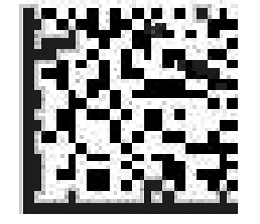 The grey areas of this symbol will mean that it will not get the best grade for modulation.
Grid non-uniformity
 These two symbols are examples showing a high degree of grid non-uniformity.
Fixed pattern damage
 The example shows defects in the L-shaped finder pattern and in the clock track.